Kaffir is a derogatory epithet for Black people in South Africa. This is a dictionary of Nguni languages, with a focus on isiXhosa. It was compiled by Albert Kropf and edited (in this second edition) by Robert Godfrey.
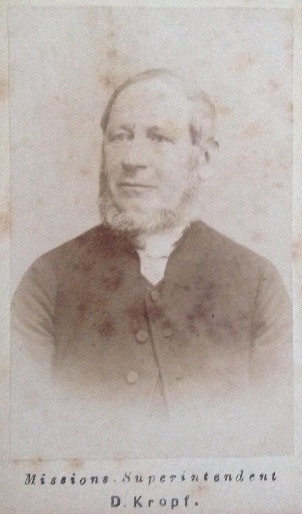
Figure 1. Albert Kropf
Xhosa (isiXhosa) is a Bantu language spoken in southern Africa. With Zulu, Ndebele, Swati, and other languages, it forms the Nguni language family. About 8 million people speak Xhosa. It is an official language of South Africa.
isiXhosa is referenced as:
xho in Ethnologue (https://www.ethnologue.com/search/?q=xhosa)
S41, Xhosa, IsiXhosa, "Kaffir" in Maho’s updated Guthrie Classification Codes
https://en.wikipedia.org/wiki/Xhosa_language
In addition to collecting vocabulary himself, Kropf mentions building on a vocabulary written by John Bennie in 1830 and a Dictionary of the Kaffir language by W.J. Davis in 1872. Robert Godfrey names several scholars who supplied technical help and mentioned that "the girls of Lovedale and Pirie have greatly assisted me in collecting Hlonipa words", which is presumably a dialect of Xhosa. He also credits the "native compositors" who printed the dictionary with providing "great assistance in the definitions of words."
This is the second edition of Kropf's Kaffir-English dictionary. There appears to be significant overlap in the language sources between Zulu and Xhosa (which the editors called Kaffir). For instance, Robert Godfrey, editor of the second edition, excised many entries "as belonging to Zulu", yet he also acknolwedges his use of Zulu dictionaries to assist in compiling this dictionary.
This edition of the book includes a signifiant introductory section detailing the grammar of verbs and nouns, including extensive discussion of noun classes.
This is a bilingual dictionary arranged according to the stem of each word with definitions in English only and some sample phrases in isiXhosa.
[prefix-] [Headword,] [part of speech abbreviations] [class prefixes.] [Translation {Phr.}: sample, sample translation}] [usage note] [, see related word].
| Item | Formatting | Notes | Database correspondant | ||
| 1. | Prefix | Lowercase, followed by a dash. | Grammatical information | ||
| 2. | Headword, | Bold, followed by comma | Headword | ||
| 3. | Part of speech abbreviations | Italicized, separated by periods | See chart 3 | Part of speech | |
| 4. | Class prefixes | Separated by periods | See chart 2 | Grammatical information | |
| 5. | Translation | Multiple translations will be separated irregularly | Definition | ||
| 6. | Sample, (Phr.) | Italicized | Translation will have a colon after, sample sentence followed by a comma. Sometimes sample will have Phr. in front of it | Example | |
| 7. | Sample translation | If multiple sample sentences/translations, see notes | Translation of example | ||
| 8. | Usage note | May or may not be in parentheses | Usage notes referring to the translation of headword will be put in definition. Usage notes referring to the sample phrase will be put in the example. Usage notes referring to the sample translation will be put in the translation of example | ||
| 9. | See related word | Related word is italicized | Comma after translation, followed by period. | Related |
Figure 2 Template notes
Abā, Those yonder, see Abaya.
uku-Gontya, = uku-Gongxa
Abo, (a) Dem. pron. I cl. pl. Those: abobantu, those persons. It’s meaning stands midway between aba and abaya; aba, those by me; abo, those by you; abaya, those yonder. b) Pron. poss. 3 p. pl. ref. to 2 cl. pl. Their; amazwi abo, (abantu) their (the people’s) words; and 7 cl. Its: ukufika kwabo (ubukumkani), it’s (the kingdom’s) arrival; see Bo, I (b).
is-Abongo, n. 4. Foul, offensive eructation from the stomach after eating anything with an offensive smell, or drinking too much; ub’odl’ isab'ongo, he casts up a bad smell.
u-Godo,n. 5. A stiff, rigid, motionless thing, as a dead body, mummy; a dry skin of an animal; a dry carcase. Phr. wamdala ugodo, he made himself stiff, i.e. he killed him; isonka sokuza kusa silugodo njengomsila wenja, the bread of dawn is dry and stiff like a dog’s tail.
i-Gogosholo, n. 2. One who hides something under the arm or on the chest; fig. a boaster; one who puffs himself up like a peacock.
in-Gongobala, n. 3. (a) A song at a drinking bout, accompanied by dancing in a nude state. (b) A round elevation.
We have often expanded abbreviations in the database. However, users consulting the images may find the abbreviations table below helpful.
| absol. | absolute | |
| adj. | adjective | |
| adv. | adverb | |
| aor. | aorist | |
| app. | appendix | |
| aux. | auxiliary | |
| card. | cardinal | |
| caus. | causative | |
| cf. | compare | |
| cl. | class | |
| comp. | compound | |
| condit. | conditional | |
| conj. | conjunction | |
| conj. and conjunct. | conjuctive | |
| contrac. | contracted | |
| cop. | copula | |
| dem. | demonstrative | |
| dict. | dictionary | |
| dimin. | diminitive | |
| distrib. | distributive | |
| Du. | Dutch | |
| e. g. | For example | |
| Em. | Embo (fingo) | |
| emphat. | emphatic | |
| Eng. | English | |
| esp. | especially | |
| etc. | Et cetra (and so on) | |
| euphem. | euphemistic | |
| fig. | figuratively | |
| fr. | from | |
| fut. | future | |
| Hl. | Hlonpia | |
| i. | intransitive | |
| i. e. | That is | |
| imperat. | imperative | |
| imperf. | imperfect | |
| ind. and indicat. | indicative | |
| indef. | indefinite | |
| infinit. | infinitive | |
| intens. | intensive | |
| interj. | interjection | |
| interrog. | interrogative | |
| Kaf. | Kafir | |
| lit. | literally | |
| loc. | locative | |
| n. | noun | |
| N.B. | Note well! | |
| neg. | negative | |
| num. | numerical | |
| obj. | Object, objective | |
| orig. | originally | |
| p. | person | |
| partic. | Participle or particle | |
| pass. | passive | |
| perf. | perfect | |
| pers. | personal | |
| phr. | phrase | |
| pl. and plur. | Plural | |
| pluperf. | pluperfect | |
| poss. | possessive | |
| pot. and potent. | potential | |
| pref. | prefix | |
| prep. | preposition | |
| prepos. | prepositional | |
| pres. | present | |
| pron. | Pronoun or pronominal | |
| ref. | referring | |
| refl. or reflex. | reflexive | |
| rel. | relative | |
| sing. | singular | |
| subj. | Subject, subjective | |
| t. | transitive | |
| temp. | temporal | |
| us. | used | |
| v. | verb | |
| viz. | namely | |
| voc. | vocative | |
| Z. | Zulu |
The editors included extensive discusions of each noun class, including the kinds of nouns in each class, the formation of nouns from various kinds of verbs and adverbs, and how they can be combined into compound nouns. They describe Kaffir (isiXhosa) as having 8 classes, grouping both the singular and plural forms into the same class.
| Class | Sing. | Plur. | |
| 1. | um | aba (abe, ab) | |
| u | o | ||
| 2. | ili (i) | ama (am) | |
| 3. | in | izin (in) | |
| im | izim (im) | ||
| i | i | ||
| 4. | isi (is) | izi (iz) | |
| isa | iza | ||
| 5. | ulu (ul, ulw) | izin, izim, izi | |
| ulwa | iza | ||
| u | in, im, i | ||
| 6. | um (u) | imi | |
| 7. | ubu (ub, uty) | ||
| 8. | uku (uk, ukw) |
The following chart adapts the dictionary treatment of noun classes to HALD’s standardized chart.
| Class | Marker | Number | |
| 1 | u-, um- | Singular of 2 | |
| 2 | o-, aba-, abe-, ab- | Plural of 1 | |
| 3 | um-, umu- | Singular of 4 | |
| 4 | imi- | Plural of 3 | |
| 5 | ili-,i- | Singular of 6 | |
| 6 | am-, ama- | Plural of 5, 15 | |
| 7 | isi-, isa- | Singular of 8 | |
| 8 | iz-, izi, iza- | Plural of 7 | |
| 9 | i-,in-, im- | Singular of 10 | |
| 10 | i-,in-, im-, izini-, izim-, izi-, iza- | Plural of 9, 11 | |
| 11 | u-, ulu-, ul-, ulw-, ulwa0 | Singular, no plural | |
| 12 | Singular of 14 | ||
| 13 | Both singular and plural | ||
| 14 | ub-, ubu-, uty, | Plural of 12 | |
| 15 | uku-, uk, ukw-, | Singular of 6 | |
| 16 | Locative | ||
| 17 | uku-,uk-ukw, | Locative | |
| 18 | Locative | ||
| 19 | |||
| 20 | Singular of 22 | ||
| 21 | |||
| 22 | Plural of 20 | ||
| 23 | |||
| 24 | |||
| 25 | Locative |
 Dictionaries
 Search
 Browse
 People