This is a dictionary of the Maa language spoken by Maasai peoples
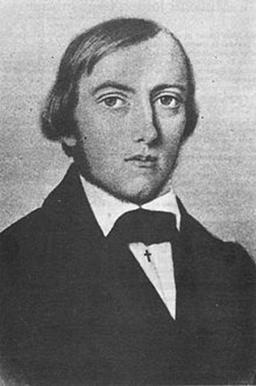
Figure 1. J. Erhardt
Maa is an Eastern Nilotic language spoken by around 1.5 million people in Eastern Africa. Jakob Erhardt labeled it Enguduk(the language) of the Iloigib, which is more commonly rendered Loikop in English. In a preface written by Johannes Krapf (who worked with Erhardt as a missionary in Rabai and Mombasa), the people who spoke this language are identified as Maasai and their language as kiMasai. Krapf distinguished this people and language from the Kwavi, whose language he documented in an 1854 Kikwavi dictionary. Both languages are now regarded as dialects of Maa.
Maa is referenced as:
mas in Ethnologue (https://www.ethnologue.com/language/mas/)
As a Nilotic language, Maa does not appear in Maho’s updated Guthrie Classification Codes or Bantu languages
https://en.wikipedia.org/wiki/Maasai_language
According to Krapf, Erhardt collected most of his vocabulary from Swahili traders and "Natives of various African tribes" on the East African coast, rather than travelling into the interior where the primary speakers of the language lived.
Krapf notes there are discrepancies between his knowledge of Kwavi and Erhardt's record of Iloigib, but could not authoritatively say who was correct. The only major change he claims to have made to the dictionary was to adopt the standard alphabet of Dr. Lepsius, which is based on the Latin alphabet but with many diacritics.
This is a bilingual dictionary, with a Maa-English section followed by an English-Maa section. Entries include singular and plural forms or Maa nouns, parts of speech, sentence length definitions, and some cultural and grammatical comments by Erhardt.
[headword,] [particle] [(notes on particle)] [part of speech abbreviation {(note on part of speech)}] [definition. (notes on definition.)] [notes on plural] [notes on derivation] [{part of speech} sample phrase] [sample phrase translation.]
| Item | Formatting | Notes | Database correspondant | |
| 1. | headword | All lowercase, followed by a comma. | Headword | |
| 2. | particle | Found with nouns and verbs, see section below for details. Can be added to "grammatical information" field, and should also inform part of speech field. | Grammatical information | |
| 2. | Notes on particle | In parentheses | Can be added to "grammatical information" field | Grammatical information |
| 3. | Part of speech abbreviation | May be followed by a note on the part of speech, which will be in parentheses. Usually left out if the particle already clarifies the part of speech. | Part of speech | |
| 4. | Definition | May be followed by notes on the definition, which will be in parentheses. | Definition | |
| 5. | Notes on plural form | Can be added to "grammatical information" field | Grammatical information | |
| 6. | Notes on derivation | May or may not be in parentheses | Derivations | |
| 7. | Sample phrase | May be prefaced by a part of speech | Example | |
| 8. | Sample phrase translation | Translation of example |
Figure 2 Template notes
ákwi, s. (without article) grandfather. akwilái my grandfather.
ēo. yes. (female reply.)
gol, a. to be healthy strong, vigorous. prf. adagólo (o)gol adj. masc. (na)gol adj. fem. Strong.
góre, e. s. grumbling, wrath. v. ádagóre to be — angry — to be wrath.
gudukáji. s. house-door. (lit. the mouth of the house) From eng-uduk mouth & and eng-áji house.
nalunlúnga, (part.) adj. Fem. healthy, well.
áiu, en. lit. the bearing or bringing to life, pro genitress, mother. pl. in áiu. In form, this word is the fem. participle of the present tense with the article. By this name a mother is made mention of after her death. Every person’s name is changed after death, from the superstitious belief, that he would make his appearance and trouble the survivors if called by the name he bore ; to avoid all unpleasantness of that kind, the names are changed, the departed not knowing what their new appellations are, can rest in quietness. The greatest insult to a Masai is, to mention in his presence his departed friends by their former name ; such a one he will never let unrevenged.
áji, eng. house. or rather hut, consisting of a frame work of wood, covered with raw hides. pl. ing ájijik. this house-enáhi, not as it regularly out to be enagáji.
di, a. to be. prf. adidúo to have been. idiáji? art thou at home? nadiaji. I am at home. ēdorldungnáni súbad, he is not a good man.
dódu, a. to lift off the fire – take away. v. n. to disappear, vanish. Imp. dadódu ; endadódu. prf. adadóduo.
[headword, {notes on headword,}] [part of speech abbreviation] [either: {notes on headword —} or {(notes on headword)}] [translation.] [notes on plural] [sample phrase] [sample phrase translation. {notes on translation}]
| Item | Formatting | Notes | Database correspondant | ||
| 1. | headword | Lowercase and followed by a comma. | Notes on headword may follow, and they will be followed by a comma. | Headword | |
| 2. | Part of speech abbreviation | Part of speech | |||
| 3. | Notes on headword | If the notes are not in parentheses, they will be followed by an em dash. If the notes are in parentheses, no em dash will follow. | Definition | ||
| 4. | Translation | Definition | |||
| 5. | Notes on plural | Can be added to "grammatical information" field | Grammatical information | ||
| 6. | Sample phrase | Example | |||
| 7. | Sample phrase translation | May be followed by notes on translation | Translation of example |
Figure 2 Template notes
abdomen, s. eng-ošóke. pl. Ingoišua.
able, v. to be. a-idim. prf. aidima.
again, adv. si. uóu si — come again.
alike, v. n. to be — a-uána. prf. adiwána. In kisuaheli ku-fanána.
boy, s. orl-barnódi. pl. ilbarnòd. lit. the calabash-scraper. on these young members of the imboidan lie all the menial services for the ilmuràn, for whom they must fetch water, fuel etc. An orlbarnódi has already joined the warriors.
mkuafi, s. (as he calls himself) orl-oigob. pl. iloigob.
We have often expanded abbreviations in the database. However, users consulting the images may find the abbreviations table below helpful.
| adj. | adjective | |
| adj. fem. | feminine adjective | |
| adv. | adverb | |
| card. | cardinal number | |
| conj. | conjunction | |
| interj. | interjection | |
| fem. | feminine (appears in combination with other parts of speech, either in the part of speech slot or later in the entry as grammatical information) | |
| masc. | masculine (appears in combination with other parts of speech, either in the part of speech slot or later in the entry as grammatical information) | |
| s. | noun (from substantive) | |
| s. gen. fem. | generic feminine noun | |
| s. gen. masc. | generic masculine noun | |
| prep. | preposition | |
| pron. | pronoun | |
| pron. poss. | possessive pronoun | |
| pron. poss. fem. | feminine possessive pronoun | |
| pron. poss. masc. | masculine possessive pronoun | |
| pron. demon. | demonstrative pronoun | |
| pron. dem. fem. | feminine demonstrative pronoun | |
| pron. dem. masc. | masculine demonstrative pronoun | |
| pron. pers. 2d prs. | 2nd person personal pronoun | |
| v. | verb | |
| v. pass. (or vpass.) | passive verb | |
| v. n. | neuter verb (what we would today call a stative verb, expresses a state of being) | |
| v. a. | active verb (i.e., an action verb, not a neuter/stative verb) | |
| v. a. & n. | active and neuter verb |
| vid. | see (from Latin vide, put this in "related words" field) |
| comp. | compare (this appears to be used interchangeably with vid., so also put this in "related words" field) |
| pl. | plural (put this in "grammatical information" field) |
| Imp. | imperfective (a kind of past tense) or imperative, (put this in "grammatical information field) |
| prf. | perfective (a kind of past tense, put this in "grammatical information" field) |
| lit. | literally (don't need to do anything with this) |
| i.e. | that is/in other words (from Latin id est, don't need to do anything with this) |
| part. | participle (this usually appears in parentheses with adjectives, it should go in grammatical information) |
| contr. | contracted (indicates a contracted form, should go in grammatical information) |
There are no Noun Classes in Nilotic langauges like Maa.
“Particle” is a linguistic term that refers ambiguously to small functional morphemes such as prefixes/suffixes, articles, or other similar words. Maa nouns have particles that are somewhere between a prefix and an article, and Maa verbs have an infinitive particle that is somewhere between a prefix and a preposition. We'll just use the term “particle” to refer to these.
Maa has three noun classes: masculine, feminine, and place. Masculine nouns get the particle orl/l or o (plural il/i), Feminine nouns get the particle eng/enc, en, em, or ē̱/e (plural ing/in/im/i). Some feminine nouns can also have a collective sense, in which they have no plural and take the particle el. The “place” noun class described in modern grammars may overlap with this collective sense, but Erhardt does not discuss it, so we'll just refer to these as “collective nouns”.
Entries for nouns list the singular particle between the headword and definition. They usually do not list the part of speech (s. for noun/substantive), as this would be redundant since if it has one of these particles then it's a noun. They will usually list the plural form at the end, preceded by pl. Some nouns will list “(without article)” in place of the particle. Rarely, nouns will be presented just in the plural form, in which case the plural particle will be listed [for example: ma̍o, il (pl. form) twins].
Verbs will likewise often skip the part of speech if the particle is listed.
| Article | Part of speech field | Grammar info field | |
| orl | "masculine noun" | "orl" (plus the plural form, if provided) | |
| l | "l" (plus the plural form, if provided) | ||
| o | "o" (plus the plural form, if provided) | ||
| il | "il (plural form)" | ||
| eng | "feminine noun" | "eng" (plus the plural form, if provided) | |
| enc | "enc" (plus the plural form, if provided) | ||
| en | "en" (plus the plural form, if provided) | ||
| em | "em" (plus the plural form, if provided) | ||
| ē̱ | "ē̱" (plus the plural form, if provided) | ||
| e | "e" (plus the plural form, if provided) | ||
| ing | "ing (plural form)" | ||
| in | "in (plural form)" | ||
| im | "im (plural form)" | ||
| el | "collective noun" | "el" | |
| a | "verb" | "a" |
 Dictionaries
 Search
 Browse
 People