A dictionary of Luganda (also known as Ganda) words, complete with translations from Luganda to English and English to Luganda, compiled by George Lawrence Pilkington. The dictionary also includes some grammatical information, and some prayers and scriptures translated into Luganda in the Appendix.
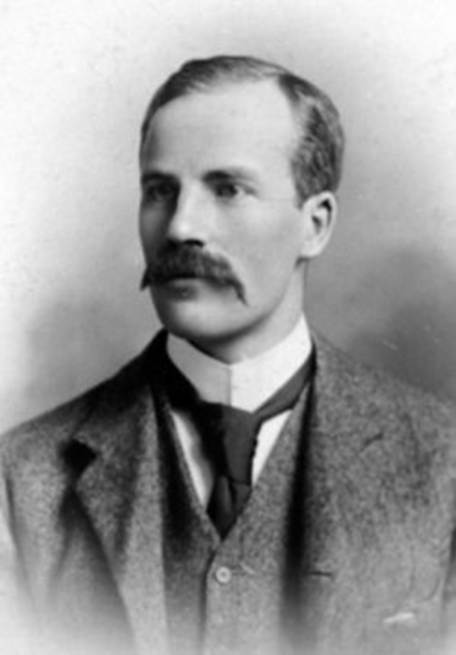
Figure 1. George L. Pilkington
“Luganda is ten times as hard as Swahili; true, Swahili is the easiest language in the world to get a superficial knowledge of, but Luganda is undoubtedly difficult."
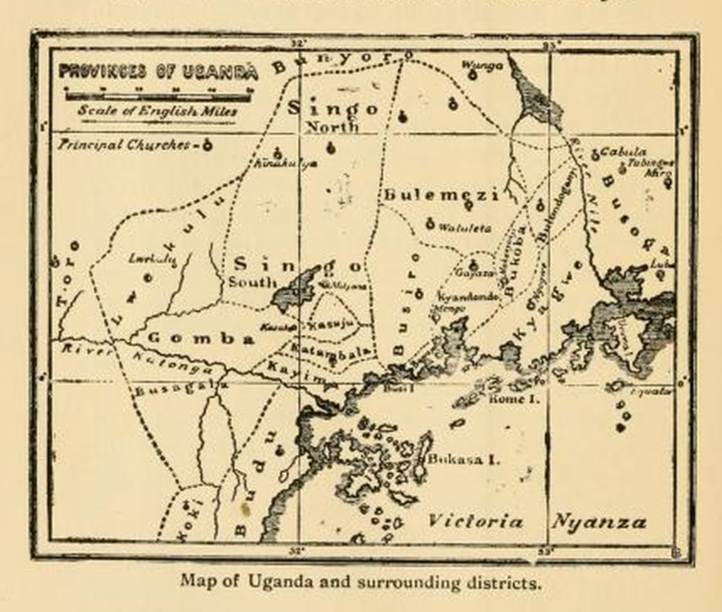
Figure 2. Map of Uganda, approx. 1899
Luganda, or Ganda, is spoken as a first language by more than 5.5 million people in the Great Lakes Region of East Africa, and as a second language by another 5 million. It is the lingua franca of Uganda.
Luganda is referenced as:
LUG in Ethnologue (https://www.ethnologue.com/language/lug/)
JE.15 Ganda, Luganda in Maho’s updated Guthrie Classification Codes
https://en.wikipedia.org/wiki/Luganda
Pilkington mentions Henry Wright Duta and speakers of Luganda as major informants for his translation work. Henry Duta later published Luganda Phrases and Idioms for New Arrivals and Travellers in Uganda with Charles W. Hattersly in 1904. Pilkington suggested that earlier missionary work by Alexander M. Mackay, Robert Pickering Ashe, []Gordon, and []Walker enabled Luganda speakers to identify the most appropriate words for translating Christian vocabulary before he arrived.
Pilkington appended this note to the English-Luganda portion of his vocabulary: "N.B. This Vocabulary is only intended to facilitate reference to the Luganda-English Vocabulary: the exact meaning and usage of the Luganda words must be found by reference to that Vocabulary. The words given are intended rather as suggestions for translation than as exact translations."
In a letter from 1892, Pilkington gave a description of how he used a "Root" dictionary to help elicit vocabulary:
“I aim at 20,000 words. I don’t think I shall find this difficult. Luganda is a very wealthy language. I think it will be necessary to go in for a little Luyima (or Kituse) and Lusoga to do the root work perfectly. These three languages are barely more than dialects and throw enormous light on one another. So does Swahili, but to a much smaller extent. I have also written, some time ago, for a Zulu grammar, as I have reason to think (I have a Zulu Prayer Book) this language is very closely aligned with Luganda.
“...Luganda is entirely different from and superior to Swahili. Out of a considerable number of Lusoga words I have got, five, I think, in every ten are identical with Luganda, four the same root, modified, perhaps, and with a different prefix, and one a totally different word, although often a word which also occurs in Luganda but in a different sense. In the Root dictionary, I hope to be able to include (by a simple system of signs that won’t, I think, interfere with its usefulness and handiness for Luganda) a good many Lusoga and Luyima and Lunyoro words—the roots being identical in so many cases, this will not be difficult in a root dictionary; and where they differ they do so by regular cases.
“It would be well still to have a Vocabulary on the old system, as in Steere’s book, for beginners, containing the words in everyday use only.
“...In order to give you a better idea of what I propose to do in the Dictionary, I give you a couple of roots worked—good specimens of course; you mustn’t suppose that all roots are equally prolific, but I think you will admit that these to be very pretty.
“Three thousand such roots would give a very ample vocabulary.”
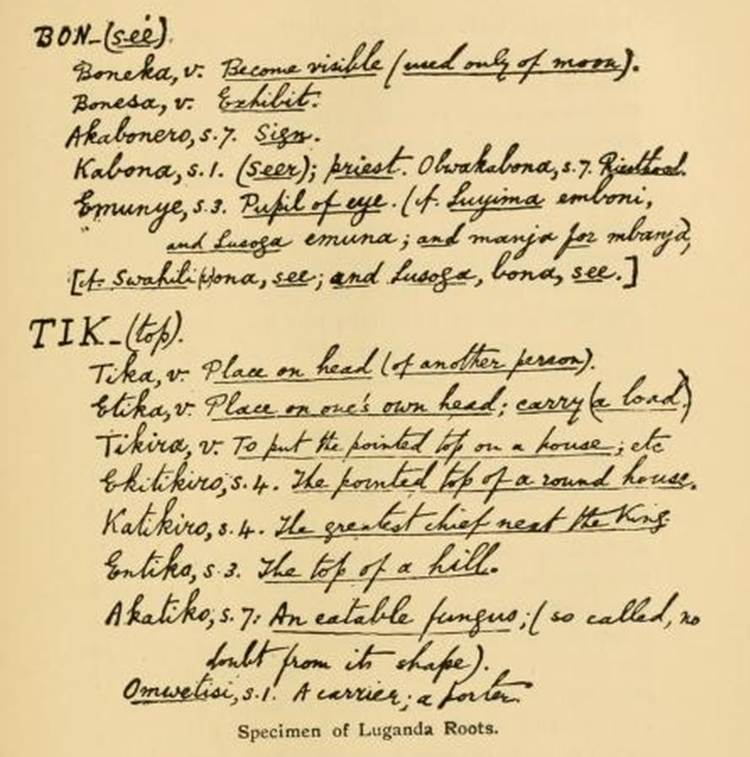
Figure 3. Specimen of Luganda Roots, pg. 199
Pilkington Letter and Figure 3 provided by ‘Pilkington of Uganda’ by Charles F. Harford, 1899, pages 197-199. Available at: https://archive.org/details/pilkingtonofugandaflem00harf/page/248/mode/2up
Pilkington describes his bilingual dictionary as a vocabulary. It also includes Appendix 1: a translation of the "Pilgrim's Progress" into Luganda with extensive translation notes that analyze Luganda morphology; Appendix 2:Idioms and phrases; Appendix 3: A grammatical comparison of Kiswahili and Luganda; Appendix 4: translationsof common Christian prayers into Luganda.
[Headword,] [part of speech abbreviation {, word class note,}] [-suffix.] [Translation {(usage note)}.] [Sample sentence,] [Sample translation {(usage note)}.] [[note on word.]] [See {related word or part of speech}].
| Item | Formatting | Notes | Database correspondant | |
| 1 | Headword | Followed by a comma | Headword | |
| 2 | Part of speech abbreviation | Italicized | See chart 2 | Part of speech |
| 3 | Word class note | Italicized | See chart 3 | Notes |
| Plural information | All lower case. Format: [pl. of ____], with both [pl.] and [the plural] italicized | Grammar info | ||
| 4 | Translation | First letter is upper case | Followed by a period if there's no usage note. Multiple translations irregular, see notes. | Definition |
| 5 | Usage note | In parentheses | Followed by a period | Definition |
| 6 | Sample sentence | Italicized | Followed by a comma | Example |
| 7 | Sample translation | Followed by a period if there's no usage note | Translation of example | |
| 8 | Usage note | In parentheses | Followed by a period | Translation of example |
| 9 | Note on word | In brackets | Period inside of brackets | Grammar info |
| See {related word or part of speech} | Followed by period. Irregular, see notes | Related |
Figure 4 Template Notes
Aba, abe, abo, prep. Of (initial vowel, preposition, and initial vowel of next word).
Abo, dem. pron., 3rd pers. pl., referring to first class. These, they, them.
Alira, v. Spread in (a place). Kwalira munju, to spread a room (with mats).
Akayakana, v. Glitter, shine. [Reduplicated and reciprocal form of aka.]
Atikirira, v. (i.) Be well known, famous. (ii.) Be torn in many places (esp. used of bad bark-cloth, when the fibre is split in many places).
Aza, v. (i.) Increase (tr.). (ii.) Look for in, search.
Baze, s. 1. Husband. Baze wange, my husband.
Bamu, pl. of –mu, one. Some. See Pronouns.
Banda, s. 5. Bamboo. See MAMVU and KIBAMVU.
Banga, s. 5. Space (of time or distance); room; occasion, opportunity. Ba ma banga, Be open.
Abika, v. Be bust, torn. Ayabika olubuto, His stomach is bursting. Ekita kyabise, The calabash is broken.
Aka, v. Burn, blaze, be hot. Omusana gwaka nyo, The sun is very hot. [Sw. waka.]
Baja, v. Work with an axe, do carpenter’s work. Verb. adj. -baje.
Bambula, v. (i.) Make raw with fire, blister or stick. (ii.) Pull up a spear which has been stuck upright in ground. SEE SIMBA.
[Headword,] [(part of speech).,] [(abbreviation note on usage),] [part of speech abbreviation.,] [(usage note),] [exact translated word.] [See RELATED WORD.]
| Item | Formatting | Notes | Database correspondant | ||
| 1 | Headword | Followed by comma | Headword | ||
| 2 | Part of Speech | Italicized. Followed by a period and a comma | Part of speech | ||
| 3 | Usage note | May or may not be in parentheses, followed by comma | Definition | ||
| 4 | Exact translated word | Followed by period. | Multiple words separated by commas or semicolons. | Definition | |
| 5 | See RELATED WORD | Related word in all caps, followed by period | Related |
Figure 5 Template Notes
Abandon, leka, senguka, julula.
Abase, gya or goba mu kitibwa.
Able, to be, inza.
Able, wa maanyi; wa magezi.
Advance (tr.), wola, azika.
Again, nate. See MULUNDI.
Alarm, v., tisa.
Mangle (tear), tangula.
Low, v., (of cattle), kaba.
Milk, sweet, masununu.
Moon, new, mwezi ogubonese.
Minute (a minute thing), kasirikitu.
Accordingly, ao; kubera ekyo. See –VA, -TYO.
Advance (intr.), genda mu maso; kulembera.
Low, wansi, kumpi nensi, mpi; (of sound) nene.
We have often expanded abbreviations in the database. However, users consulting the images may find the abbreviations table below helpful.
| adj. | adjective | |
| adv. | Adverb | |
| dem. pron. | Demonstrative pronoun | |
| interj. | interjection | |
| pl. | Plural | |
| prep. | preposition | |
| s. | Substantive (noun) | |
| v. | Verb | |
| Variable prep. | Variable preposition |
Figure 6 Part of Speech Abbreviations
| i.e. | For example | |
| tr, | Transitive | |
| q.v. | See also (quod vide) | |
| Sw. | Swahili |
Figure 6 Other Abbreviations
Pilkington described noun classes in his comparison of Luganda to Kiswahili in Appendix 3. He does not provide any prefixes and omits plurals in the dictionary unless they are irregular. However, he says Kiswahili has 8 classes and Luganda has 12, seven of which are similar to the classes in Kiswahili.
< p> Conventionally, nouns in Luganda are grouped into 10 noun classes (each including a single and plural), as depicted in the chart below. It is unclear what system of noun class organization Pilkington is using or referring to.| Luganda Class | Number | |
| I (MU-BA) | Singular | |
| Plural | ||
| II (MU-MI) | Singular | |
| Plural | ||
| III (N) | Singular | |
| Plural | ||
| IV (KI-BI) | Singular | |
| Plural | ||
| V (LI-MA) | Singular | |
| Plural | ||
| VI (KA-BU) | Singular | |
| Plural | ||
| VII (LU-N) | Singular | |
| Plural | ||
| VIII (GU-GA) | Singular | |
| Plural | ||
| IX (KU-MA) | Singular | |
| Plural | ||
| X (TU) | (no distinction) |
The following chart adapts the conventional Luganda Bantu Noun Classes to HALD's standardized chart.
| HALD Class | Luganda Class | Marker | Number | |
| 1 | 1 | mu | Singular of 2 | |
| 2 | 1 | ba | Plural of 1 | |
| 3 | 2 | mu | Singular of 4 | |
| 4 | 2 | mi | Plural of 3 | |
| 5 | 5 | li | Singular of 6 | |
| 6 | 5 | ma | Plural of 5, 15 | |
| 7 | 4 | ki | Singular of 8 | |
| 8 | 4 | bi | Plural of 7 | |
| 9 | 3 | N | Singular of 10 | |
| 10 | 3 | N | Plural of 9, 11 | |
| 11 | 7 | lu | Singular, no plural | |
| 12 | 6 | ka | Singular of 14 | |
| 13 | 10 | tu | Both singular and plural | |
| 14 | 6 | bu | Plural of 12 | |
| 15 | 9 | ku | Singular of 6 | |
| 16 | wa | Locative | ||
| 17 | ku | Locative | ||
| 18 | mu | Locative | ||
| 19 | ||||
| 20 | 8 | gu | Singular of 22 | |
| 21 | ||||
| 22 | 8 | ga | Plural of 20 | |
| 23 | ||||
| 24 | ||||
| 25 | e | Locative |
[1] Harford, Pilkington of Uganda, page 196.
 Dictionaries
 Search
 Browse
 People