There are over 2000 languages in Africa. The majority of languages are divided into four language families indigenous to Africa: Niger-Congo, Nilo-Saharan, Afro-Asiatic, and Khoesan. In addition, the Malagasy languages found in Madagascar are classified as part of Austronesian, whose other members are found in Southeast Asia and the islands of the Pacific Ocean. Indo-European languages introduced during the colonial era are also spoken throughout the continent. Finally there are a number of language isolates in Africa that are not classified into any language family.
The map below gives a rough indication and distribution of these language families in Africa.
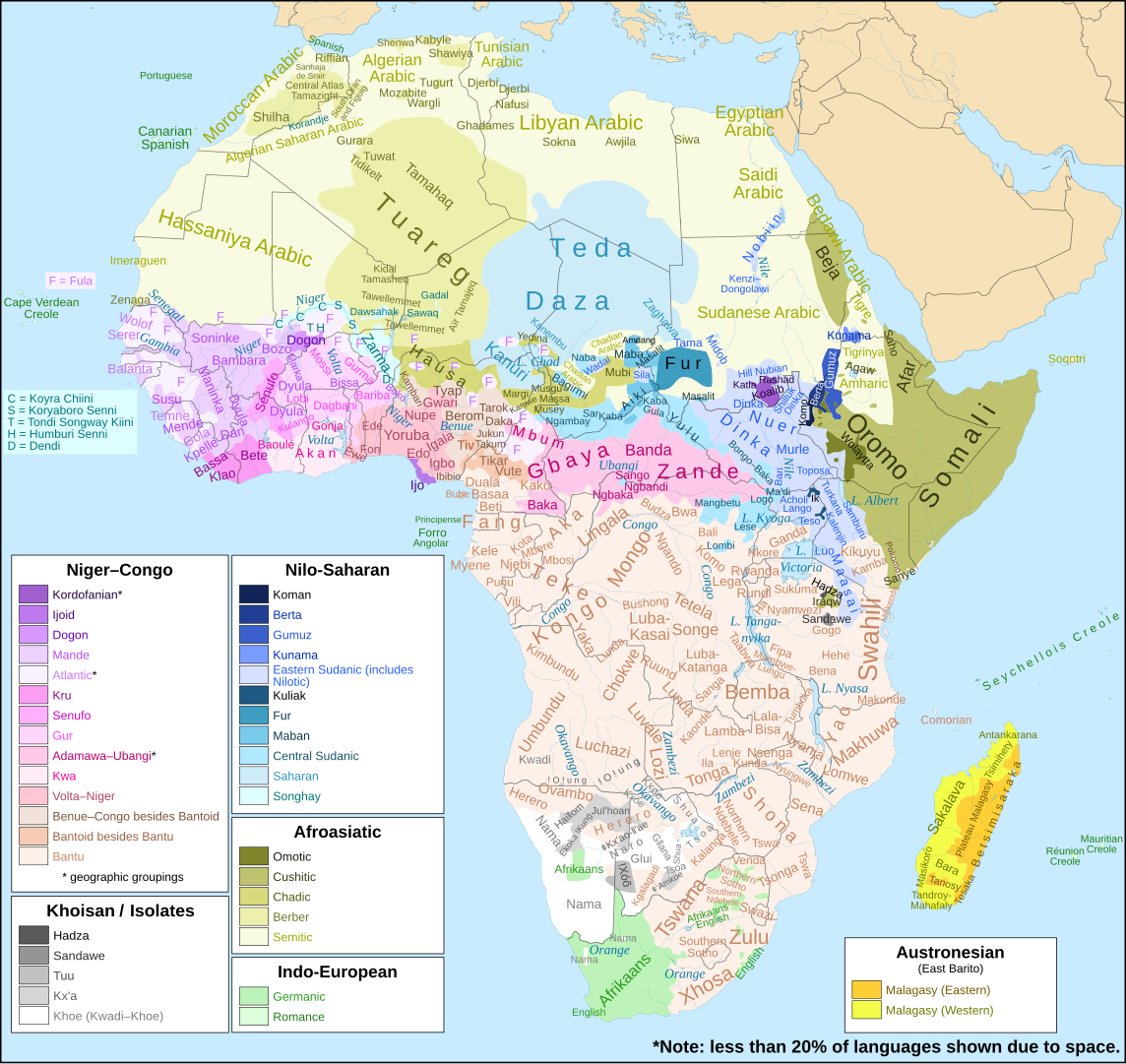
By User:SUM1 - Created from File:Africa_map_blank.svg by User:Sting. Based design on File:Map_of_the_Niger-Congo_and_Khoisan_languages.svg by User:Alphathon.Language info: compiled from various Ethnologue country maps, as also compiled in Muturzikin., CC BY-SA 4.0, Link
Bantu languages are a major sub-division of the Niger-Congo language family, with between 450 and 600 languages. These languages are spoken throughout the "trunk" of Africa. Language classification studies of Bantu languages are relatively more numerous than research about other branches of Niger-Congo or other Afican language families.
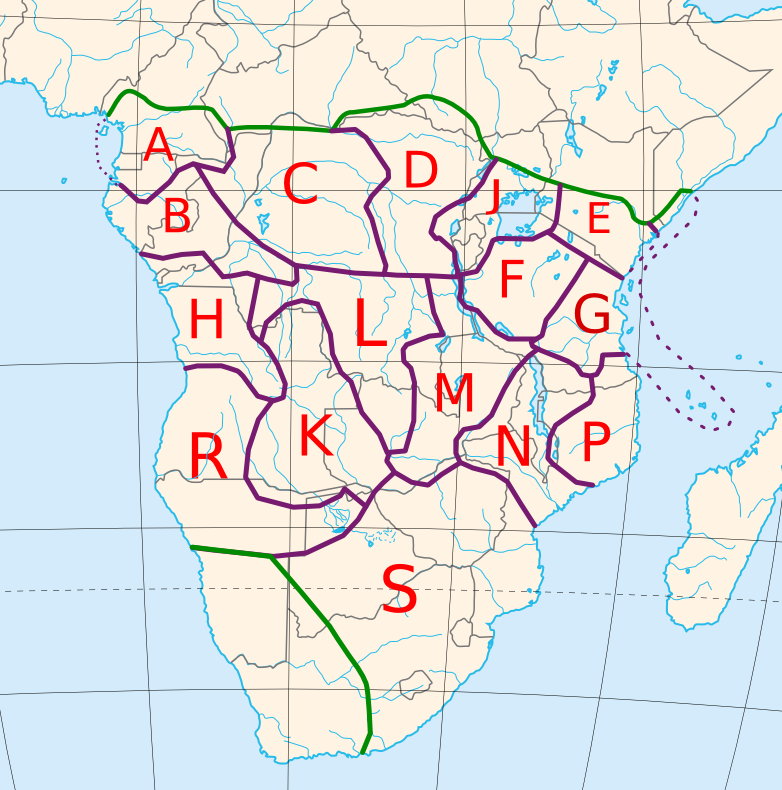
Malcolm Guthrie published an extensive reference index of over 250 Bantu languages in 1948, with an updated classification in 1971. He grouped these languages into geographical zones, labeled A-S (See map below). Although Guthrie sometimes used
apparent similarities to guide him in grouping Bantu languages, they are not genetic groupings defined by shared innovations. An exception on the map below is the J zone, a genetic grouping of languages formerly split between Guthrie's D and E zones. This zone was
developed through research by linguists at the Royal Museum for Central Africa in Tervuren, Belgium. Jouni Filip Maho updated a revised list of Bantu languages in a chapter of The Bantu Languages (2003). He has also circulated
a list accompanied by detailed maps and other updates in an online version published in 2009. Like Guthrie's classification, Maho's list is a referential catalog of Bantu languages only. The zones do not indicated genetic relationships,
except possibly Zone J.
For dictionaries that focus on Bantu languages, the Historical African Languages Database uses the "Maho" Codes from the 2009 classification
to identify the language. This enables users of the database to compare languages that are in the same geographical area. Non-Bantu languages (labeled NA) can also be selected individually for comparison.
Guthrie's original labels divided the languages of each zone into geographical decades.
E.g. A10, A20, A30.
Then within each decade, individual languages would be assigned a number that appears in the third position of the code.
E.g. A13 Balong, A15 Manenguba
In some cases, further differentiation of languages or dialects is achieved by adding a number in the fourth position
E.g. A14 Bokeng and A141 Bafo indicate different languages.
Maho's updated list follows the same pattern. However, for the J zone, he prefixes the letter J to the zone assigned by Guthrie to each language.
E.g. JE22 Haya, JD41 Konzo
These lists sometimes include dialectical variation as well, in which case a capital letter is added in the fourth position
E.g. A15 Manenguba, A15A – North-East Manenguba, A15B North-West Manenguba, A15C Central Manenguba
The distinction between languages and dialects is not always clear.
By Edricson, CC BY-SA 3.0, Link
 Dictionaries
 Search
 Browse
 People

